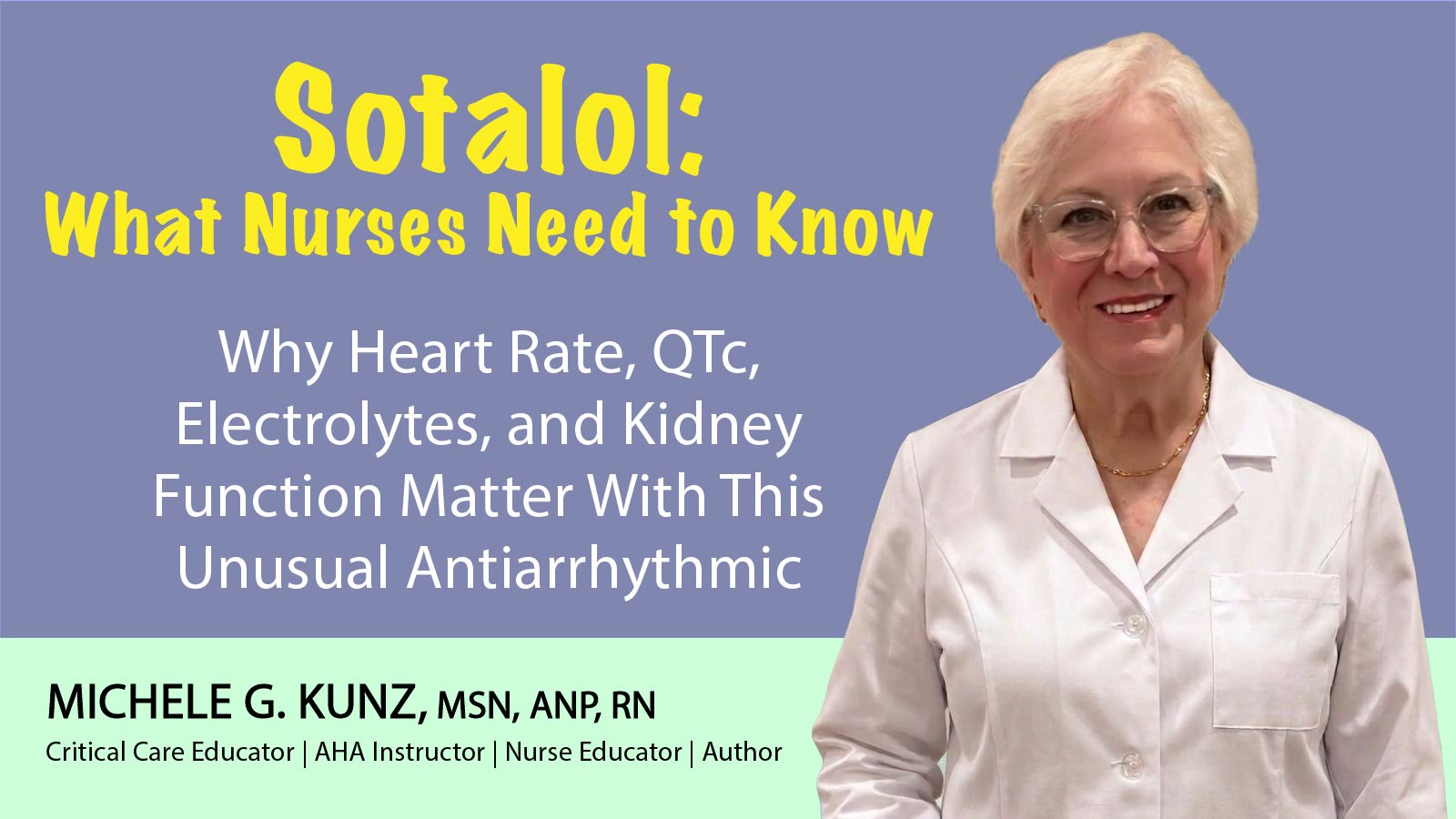
Why heart rate, QTc, electrolytes, and kidney function matter with this unusual antiarrhythmic.
Synopsis
Sotalol is an antiarrhythmic medication that nurses may recognize by name without encountering frequently enough to feel completely comfortable with it.
What makes sotalol especially important to understand is that it does two things at once: it acts as a nonselective beta-blocker and as a Class III antiarrhythmic.
That combination means nurses need to think beyond simply checking the patient’s heart rate before administering the medication.
Sotalol can slow the heart rate and lower blood pressure, but it can also prolong the QT interval and increase the risk of a potentially dangerous ventricular arrhythmia called torsades de pointes.
Kidney function and electrolyte levels—especially potassium and magnesium—also play an important role in its safe use.
Fortunately, nurses do not need to memorize every pharmacologic detail about sotalol.
A practical way to remember the medication is to think of five things:
Heart rate. QTc. Potassium. Magnesium. Kidney function.
Understanding why those five things matter can turn sotalol from an unfamiliar antiarrhythmic into a medication that makes clinical sense.
I. Introduction: More Than Just Another Beta-Blocker
There are medications we hear about constantly in nursing school, certification courses, and clinical practice.
Amiodarone is one of them.
Sotalol may not be.
You may recognize the name. You may remember that it is used to treat abnormal heart rhythms. You may even remember learning that it is a beta-blocker.
But sotalol is more interesting than that.
The most important thing to understand is this:
Sotalol is both a beta-blocker and a Class III antiarrhythmic.
Its beta-blocking effects can slow the heart rate, decrease AV nodal conduction, and lower blood pressure.
Its Class III antiarrhythmic effects prolong cardiac repolarization, which can prolong the QT interval.
That combination explains both why sotalol can be useful and why it requires careful monitoring.
Excessive QT prolongation can increase the risk of torsades de pointes, a potentially life-threatening ventricular arrhythmia. For this reason, sotalol carries an FDA boxed warning concerning QT prolongation and serious ventricular arrhythmias.
Sotalol is used in selected patients with certain ventricular arrhythmias and to help maintain sinus rhythm in patients with atrial fibrillation or atrial flutter.
It has been used for decades. It is not really a new medication or a drug that disappeared and suddenly returned.
But many nurses may encounter it much less frequently than medications such as amiodarone.
That makes it worth taking another look at.
II. Sotalol and Amiodarone: Similar Purpose, Different Nursing Concerns
One useful way to understand sotalol is to compare it with a medication most nurses already know well: amiodarone.
Both medications have Class III antiarrhythmic activity, and both may be used in the management of cardiac arrhythmias.
But they should not be thought of as interchangeable medications.
Amiodarone is well known for its broad range of possible adverse effects, especially when used long term. Nurses may associate it with concerns involving the lungs, liver, thyroid, heart, eyes, and numerous medication interactions.
Sotalol has a different safety profile.
When caring for a patient receiving sotalol, some of the most important concerns involve:
QT prolongation.
Bradycardia.
Electrolyte abnormalities.
Kidney function.
That is why asking, “Which medication is better—amiodarone or sotalol?” is not necessarily the most useful nursing question.
A better question is:
What do I need to watch for with the medication my patient is receiving?
That question brings the focus back where it belongs—on the individual patient.
III. The Five Things Nurses Should Remember: Heart Rate, QTc, Potassium, Magnesium, and Kidney Function
If you remember nothing else about sotalol, remember these five things:
Heart rate. QTc. Potassium. Magnesium. Kidney function.
Heart Rate
Remember the beta-blocker side of sotalol.
Sotalol can slow the heart rate and AV conduction.
That means the nurse should pay attention to developing or worsening bradycardia.
But there is another important reason heart rate matters.
Significant bradycardia can also increase the risk of torsades de pointes.
So checking the heart rate should not become a routine task performed without thought.
Understand why you are checking it.
A changing heart rate may be telling you something important about the effect of the medication.
QT and QTc
This may be the most important association to remember with sotalol.
Sotalol can prolong the QT interval.
Excessive QT prolongation can create conditions that increase the risk of torsades de pointes.
For nurses caring for a patient receiving sotalol, the QTc therefore becomes an important part of the medication’s safety picture.
You do not need to become an electrophysiologist to remember this relationship.
Simply train yourself to think:
Sotalol \u2192 QTc.
That one connection can make an important difference.
Potassium
Potassium matters because hypokalemia can increase the risk of dangerous ventricular arrhythmias in patients receiving medications that prolong the QT interval.
This becomes especially important in patients who are receiving diuretics or who are losing electrolytes because of vomiting or diarrhea.
Instead of seeing a low potassium level as an isolated laboratory result, connect it with the medications the patient is receiving.
If the patient is taking sotalol, that potassium level deserves attention.
Magnesium
Magnesium belongs right beside potassium in your thinking.
Hypomagnesemia can also increase susceptibility to QT-related ventricular arrhythmias.
That is why potassium and magnesium are commonly evaluated when sotalol therapy is initiated or adjusted.
The important nursing lesson is not simply:
Check the labs.
It is:
Understand why those particular labs matter for this particular medication.
Kidney Function
Kidney function is one of the easiest pieces of the sotalol picture to overlook.
Sotalol is eliminated largely through the kidneys, so renal function affects how quickly the medication leaves the body.
When kidney function declines, sotalol can remain in the body longer.
That can increase drug exposure and potentially increase the risk of adverse effects, including excessive QT prolongation.
This is why creatinine and creatinine clearance matter when sotalol is prescribed and dosed.
A helpful way to think about it is:
Kidney function declines \u2192 sotalol may accumulate \u2192 QT and arrhythmia risk may increase.
That is more useful than simply memorizing that “sotalol is renally cleared.”
It explains why the nurse should care.
IV. Connecting the Findings: Turning Pharmacology Into Nursing Judgment
The most important part of caring for a patient receiving sotalol may not be any single assessment finding.
It may be recognizing when several findings belong together.
Imagine that your patient is receiving sotalol.
This morning you notice:
The heart rate is slower than yesterday.
The potassium has fallen.
The creatinine has increased.
And the QTc is longer.
Each finding matters on its own.
But good nursing judgment means recognizing that these changes may be connected.
The slower heart rate may increase arrhythmia risk.
The lower potassium may increase susceptibility to QT-related ventricular arrhythmias.
The worsening kidney function may decrease the elimination of sotalol.
And the increasing QTc may be showing you the result.
That is when pharmacology stops being something memorized from a textbook and becomes something clinically useful.
The medication list should also be part of this assessment.
Other medications may prolong the QT interval. Some medications may further slow the heart rate or lower blood pressure.
So when caring for a patient receiving sotalol, ask yourself:
What is the heart rate doing?
What is the QTc?
What are the potassium and magnesium levels?
Has kidney function changed?
What other medications is the patient receiving?
Has the patient developed dizziness, palpitations, weakness, presyncope, or syncope?
These are not isolated pieces of information.
Together, they tell you how the patient is tolerating the medication.
That is the difference between simply administering a medication and understanding what the medication is doing.
V. Conclusion: Five Things Can Make Sotalol Much Easier to Understand
Sotalol may not be a medication you encounter every day.
But it does not need to be intimidating.
The easiest way to understand it is to remember that it has two important identities.
It is a beta-blocker, so it can slow the heart rate, decrease cardiac conduction, and lower blood pressure.
It is also a Class III antiarrhythmic, so it can prolong cardiac repolarization and the QT interval.
From those two actions come many of the nursing considerations that matter most.
So when you see sotalol on your patient’s medication list, remember:
Heart rate.
QTc.
Potassium.
Magnesium.
Kidney function.
Then look at the patient as a whole.
Has the heart rate changed?
Has the QTc increased?
Are the electrolytes normal?
Has kidney function deteriorated?
Has another QT-prolonging medication been added?
Is the patient developing symptoms that could indicate a problem?
You do not need to memorize every detail about sotalol to care safely for a patient receiving it.
You need to understand the important connections.
And that is one of the most valuable habits a nurse can develop:
Don’t just memorize what a medication is. Understand what it can change—and know what to watch.
Clinical Note: This article is for nursing education and general clinical review. See our Policies & Legal Information for important medical and educational disclaimers.
Want to Build More Confidence in Your Nursing Practice?
Nursing is more than memorizing algorithms, medications, and protocols. It also requires calm judgment, clear thinking, emotional strength, and the ability to stay present when the pressure rises.
That is why I wrote The Art of Mindful Nursing Primer.
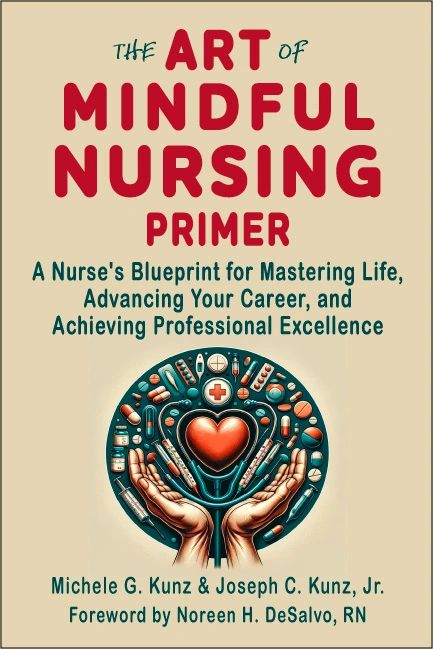
This short, practical book helps practitioners reconnect with the deeper purpose of nursing while developing the mindset needed to handle stress, uncertainty, difficult patients, demanding shifts, and the emotional weight of the profession.
If you want to become a more focused, grounded, and resilient practitioner, this primer is a good place to begin.

With over 46 years of experience as a nurse and nursing educator, Michele Kunz is a dedicated advocate for compassionate and effective patient care. As a seasoned professional, Michele has trained and certified thousands of nurses and healthcare providers, sharing her extensive knowledge and passion for nursing. Her articles aim to inspire, educate, and support nurses in their journey, promoting excellence in the nursing profession.
