How Skilled Nurses Recognize, Respond, and Lead When Seconds Matter
Synopsis
In this in-depth, real-world guide, Michele Kunz—critical-care nurse and veteran ACLS instructor—shares how to recognize and respond to unstable bradycardia with clarity, speed, and clinical confidence. Going far beyond the algorithm, Michele equips nurses and ACLS/BLS/PALS students with practical assessment tools, immediate bedside strategies, and the critical thinking needed to lead when seconds matter. Whether you're new to advanced life support or a seasoned clinician, this article delivers essential insights you can use on your very next shift.
Introduction
Unstable bradycardia isn’t rare. It’s real. And when it happens, it’s nurses like us—those standing at the bedside—who are often the first to spot it, sound the alarm, and initiate treatment.
As a critical-care nurse and ACLS instructor for over 45 years, I’ve seen it all: textbook cases, emergency codes, and everything in between. This guide will sharpen your instincts and deepen your response skills—so you act fast and decisively when every second counts.
We’ll go beyond the basics and into the real-world perspective every nurse should carry into their next shift.
A. What Is Unstable Bradycardia?
Bradycardia means a heart rate under 50 beats per minute for an adult, under 60 for infants and children—but a number alone doesn’t tell the whole story. What matters is perfusion.
Unstable bradycardia occurs when the slow rate leads to symptoms like:
- Hypotension (especially SBP < 90 mmHg)
- Altered mental status (confusion, decreased responsiveness)
- Chest pain or pressure
- Signs of shock (cool, clammy skin; delayed cap refill; weak pulses)
- Acute pulmonary edema or heart failure
Key point: Some patients can live comfortably in the 40s. Others crash in the 50s. You must assess the entire clinical picture, not just the monitor.
B. Look for the Causes—Before You Hit the Meds
To treat bradycardia effectively, you need to know what’s causing it. Medications alone won’t fix the root issue if it’s left unaddressed.
Common causes include:
- Inferior wall myocardial infarction (watch for ST elevation in leads II, III, aVF)
- Hypoxia
- Hypothermia
- Electrolyte imbalances—especially hyperkalemia
- Drug toxicity (beta-blockers, calcium channel blockers, digoxin)
- Vagal stimulation (suctioning, vomiting, bearing down)
- Advanced AV blocks
Clinical insight: If the QRS is wide and slow, think high-degree AV block. Atropine is likely to be ineffective—start preparing to use a pacemaker.
C. Immediate Nursing Actions: What to Do First
Your first steps set the tone for everything that follows. Don’t wait for the team—you are the team until they arrive.
Step-by-step:
1. Call for help immediately—don’t delay.
2. Apply a cardiac monitor and check vitals.
3. Provide oxygen and support ventilation if needed.
4. Establish large-bore IV access—or confirm patency if one is already in.
5. Position the patient flat or in Trendelenburg to improve perfusion if hypotensive.
6. Communicate clearly and calmly with your team.
7. 12 Lead ECG
Real-world advice: Say what you see. Speak loudly and clearly, using terms that everyone understands. The more confidence you show, the more your team will follow your lead.
Remember the mnemonic MOVIE:
M. monitor
O. oxygen
V. vital signs
I. IV/IO
E.12-lead ECG
D. Treatment According to ACLS: Know the Algorithm—And When to Move Fast
The AHA ACLS bradycardia algorithm offers a clear treatment pathway—but knowing how to apply it under pressure is key.
1. Atropine (First-line medication)
- Dose: 1.0 mg IV every 3–5 minutes (max total: 3 mg)
- Use for sinus bradycardia or vagal stimulation.
- Avoid relying on Atropine for second- or third-degree heart blocks—it’s often ineffective.
Tip: If you’ve already given one or two doses of atropine without improvement—stop waiting. Move to pacing or infusions (dopamine or epinephrine).
2. Transcutaneous Pacing (TCP)
- Initiate immediately if the patient is severely unstable.
- Place pads anterior-posterior for best conduction.
- Sedate if possible—TCP is extremely uncomfortable for conscious patients.
Pearl: The cardiologist/team will adjust the mA on the pacemaker. If you don’t see capture within a few seconds of increasing current, the patient may need a pacer inserted through a central line or need advanced cardiac procedures/catheterization.
3. Dopamine Infusion
- Dose: 5–20 mcg/kg/min IV
- Start low and titrate to maintain systolic BP > 90 mmHg
4. Epinephrine Infusion
- Dose: 2–10 mcg/min IV
- May be more effective in profound bradycardia with hypotension.
Teaching note: Infusions are not a long-term fix for heart block—they’re temporary measures while awaiting temporary or permanent pacemaker insertion.
E. Beyond the Algorithm: Think Critically, Act with Precision
1. Don’t Wait to Be “Sure”
If the patient is crashing, don’t wait to rule out every possible cause. With the team start the algorithm, then investigate.
2. Know Your Equipment Cold
Every nurse should know how to:
- Turn on the pacer
- Place pads correctly
- Adjust the rate and current
- Select “fixed” or “demand” (Most cardiologists choose demand and allow the patient’s heart to function on its own until it is too slow and demands the pacer to start.
- Recognize electrical and mechanical capture or failure to capture
Advice from the field:Practice during downtime. Run mock codes. The crash cart shouldn’t be a mystery. Reminder to always plug the pacer into the wall power (a point often forgotten after the initial emergency).
3. Collaborate and Lead
The best code teams work together, with a team leader assigned. Speak up. Delegate. Call out vital signs. Repeat orders. Confidence and clarity save lives
F. Key Documentation Points
1. Time of onset and symptoms
2. All vitals and rhythm strips
3. Medications and doses given (and responses)
4. Pacing details: capture achieved, rate, mA used
5. Communication: who was notified, when help arrived
6. Interventions and patient outcomes
7. Final Thoughts from Michele
Unstable bradycardia doesn’t always start with sirens and alarms. Sometimes, it’s a quiet change—a new change in mental status, dizziness, confusion, a drop in the systolic BP, or the staff or family saying, “He just doesn’t look right.”
That’s when you shine.
You don’t need to know everything. But you must know what to do— You need to act—with knowledge and courage. That’s what your patients need. That’s what teamwork looks like. That’s what real nursing is—showing up for each other and the patient when it matters most.
So, here’s your challenge: Review the algorithm. Know your crash cart. Teach others what you know. And when the time comes, act like the nurse you are—capable, courageous, and clear-headed.
Need help reviewing the heart blocks and bradycardia algorithm? Join one of my ACLS refresher courses or email me with any questions you may have. I’m here to help you grow into the nurse your patients deserve.
I know the heart blocks can be intimidating and challenging to learn and memorize. My rule is not to waste time on trying to guess which heart block it is – but to treat the patient for unstable bradycardia. So, it is better to memorize the Bradycardia algorithm.
"In moments of crisis, it’s not perfection that saves lives—it’s preparation, presence, and the quiet confidence to act. That’s the heart of great nursing." — Michele G. Kunz
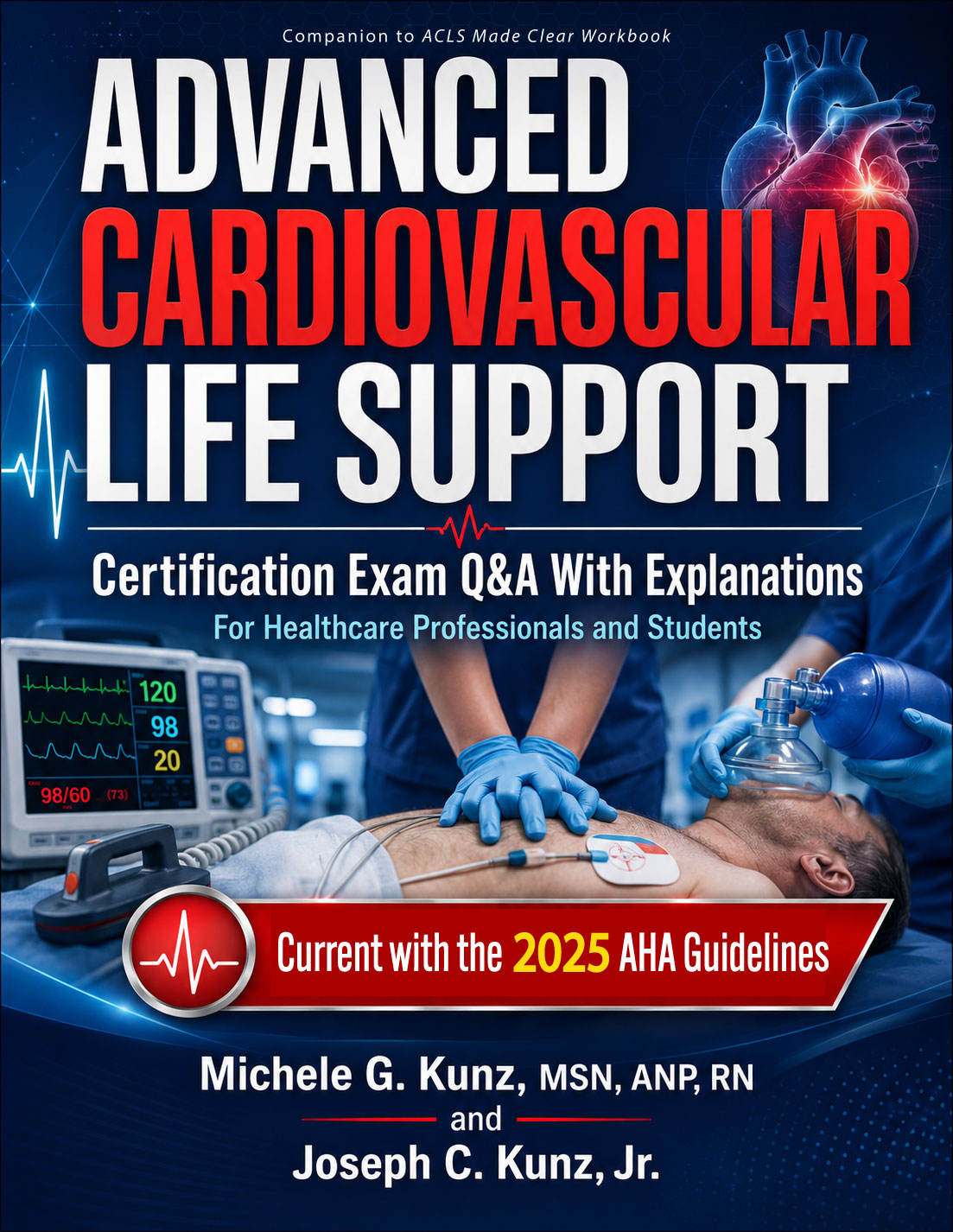
Master Your ACLS Certification with Expertise and Confidence!
Unlock the secrets to ACLS certification with this essential guide, tailor-made for healthcare professionals and students. Whether you’re aiming for certification or recertification, this book is your key to success, packed with 101 detailed questions and explanations that span the entirety of the ACLS exam spectrum.

With over 46 years of experience as a nurse and nursing educator, Michele Kunz is a dedicated advocate for compassionate and effective patient care. As a seasoned professional, Michele has trained and certified thousands of nurses and healthcare providers, sharing her extensive knowledge and passion for nursing. Her articles aim to inspire, educate, and support nurses in their journey, promoting excellence in the nursing profession.
