101 ACLS, BLS, & PALS Crossword Puzzles
For Nurses, Nursing Students, and Healthcare Professionals
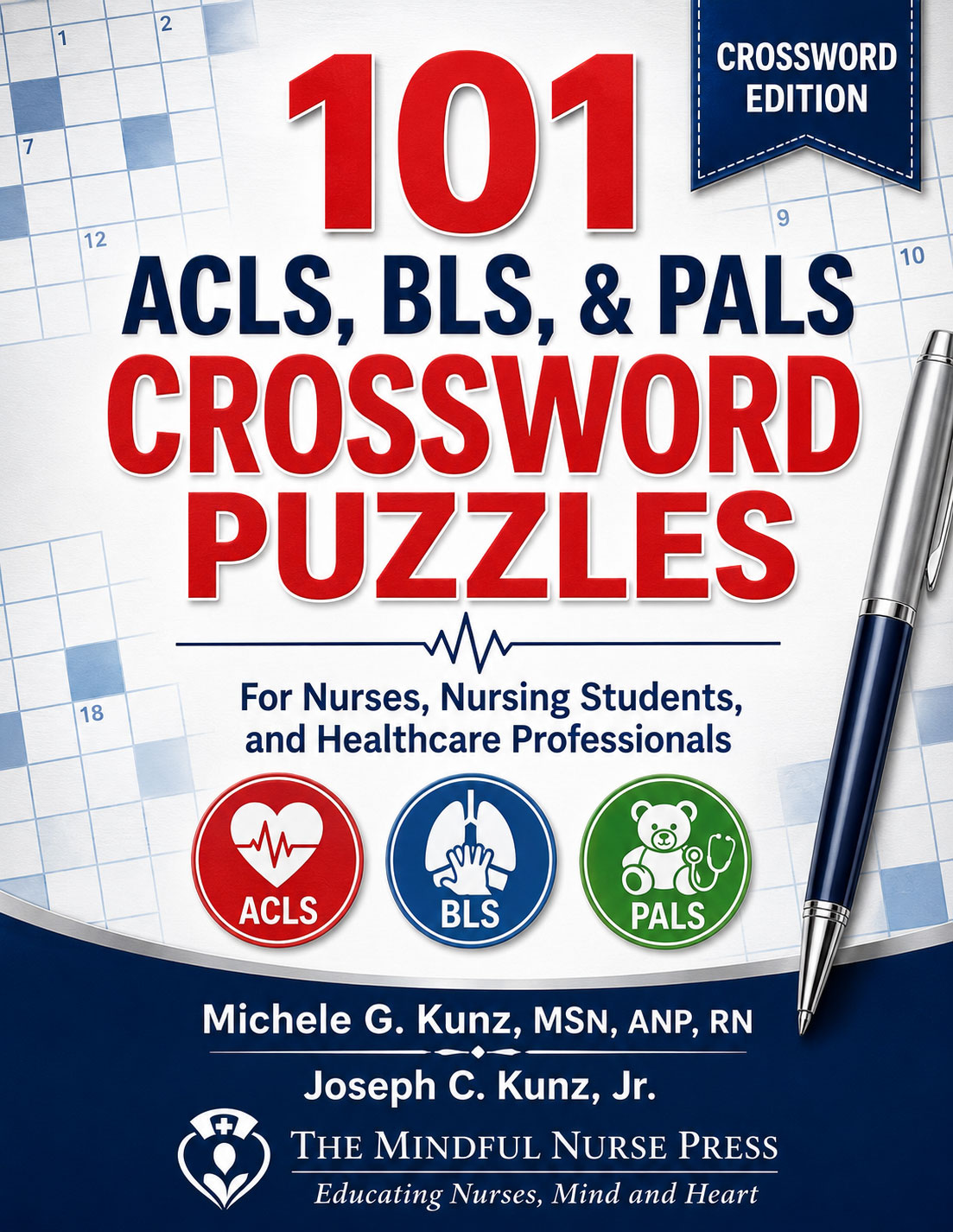
Sharpen Your Clinical Recall—One Clue at a Time
Reviewing ACLS, BLS, and PALS does not always have to mean rereading the same notes. This book turns resuscitation review into active problem-solving through 101 topic-focused crossword puzzles.
Each Across or Down clue asks you to connect a definition, medication, rhythm, intervention, assessment finding, device, algorithm concept, or emergency-care principle with the correct term. Instead of merely recognizing information already in front of you, you have to retrieve the answer from what you know—and use crossing letters when memory needs a little help.
About This Book
The book is organized as a deliberate progression through resuscitation education. It begins with the language and foundations of emergency response, moves through adult and pediatric BLS, then expands into ACLS cardiac-arrest and peri-arrest care, PALS assessment and respiratory emergencies, pediatric shock and arrhythmias, and finally three comprehensive challenges. The structure gives the puzzles educational order rather than presenting 101 unrelated grids.
Crosswords are especially useful here because the clue forces you to move from meaning back to terminology. A familiar word is not already printed in front of you. You have to interpret the clue, decide what concept it describes, and retrieve the correct answer.
What You’ll Find Inside
- Part I — Foundations of Resuscitation: 10 topics covering the language of resuscitation, cardiac arrest versus heart attack, the Chain of Survival, recognition and emergency activation, high-quality CPR, airway and breathing, oxygenation, ventilation, and teamwork.
- Part II — Basic Life Support: 22 topics covering adult and pediatric CPR, one- and two-rescuer sequences, compression-to-ventilation ratios, pulse checks, rescue breathing, bag-mask ventilation, AED use, pad placement, choking, opioid-associated emergencies, naloxone, and pediatric BLS.
- Part III — ACLS Cardiac-Arrest Management: 18 topics covering assessment, the adult cardiac-arrest algorithm, shockable and nonshockable rhythms, VF, pulseless VT, PEA, asystole, CPR quality, defibrillation, epinephrine, antiarrhythmics, vascular access, advanced airways, capnography, and reversible causes.
- Part IV — ACLS Peri-Arrest and Post-Arrest Care: 18 topics covering ROSC, post-arrest oxygenation and ventilation, hemodynamic support, temperature and neurologic care, bradycardia, pacing, tachyarrhythmias, cardioversion, adenosine, atrial fibrillation/flutter, wide-complex tachycardia, acute coronary syndromes, and stroke.
- Part V — PALS Assessment and Respiratory Emergencies: 13 topics covering the PALS systematic approach, Pediatric Assessment Triangle, primary and secondary assessment, respiratory distress and failure, upper and lower airway obstruction, lung tissue disease, disordered breathing control, oxygen delivery, bag-mask ventilation, and advanced airways.
- Part VI — PALS Shock, Arrhythmias, and Cardiac Arrest: 17 topics covering pediatric shock types, fluid resuscitation, vasoactive medications, bradycardia, tachyarrhythmias, SVT, pediatric cardiac arrest, shockable and nonshockable rhythms, defibrillation energy, weight-based medications, post-arrest care, and special pediatric cardiac conditions.
- Part VII — Comprehensive Challenges: Three concluding topics covering special circumstances of resuscitation, megacode teamwork and leadership, and an integrated ACLS, BLS, and PALS challenge.
- Complete answer key: Check your work after each study session and use missed answers to identify material that deserves another review.
- Full-size study format: The 8.5 × 11-inch pages give the crossword grids and Across/Down clues room to breathe.
Who This Book Is For
- Nursing students who want to reinforce resuscitation terminology through active retrieval rather than rereading alone.
- Nurses and healthcare professionals who want a different way to revisit familiar ACLS, BLS, and PALS concepts.
- Learners preparing for ACLS, BLS, or PALS courses or renewals who want supplemental review alongside official materials and hands-on instruction.
- Healthcare educators who want topic-focused activities that can accompany material already being taught.
- Crossword learners who enjoy solving clues and want to apply that problem-solving habit to clinical education.
How This Book Works
Each puzzle supplies Across and Down clues. The learning sequence is straightforward: read the clue, interpret its meaning, retrieve the term, and use crossing answers when needed. A clue may point to a rhythm, medication, airway concept, team role, assessment finding, procedure, or algorithm relationship.
That makes the crossword format the retrieval-focused member of the three-book series. The Word-Search edition keeps terminology visible and emphasizes recognition. The Fill-in-the-Blank edition keeps part of the statement visible and asks you to supply what is missing. The same subject matter can therefore be revisited through three different mental tasks without simply repeating the same exercise.
Why the Crossword Format Fits Resuscitation Review
Resuscitation education depends heavily on relationships: rhythm to intervention, patient status to decision, medication to purpose, assessment finding to response. Crossword clues naturally turn those relationships into small retrieval problems. When an answer does not come immediately, the crossing letters give you additional information without simply revealing the answer outright.
The goal is not to replace an ACLS, BLS, or PALS course. It is to give learners another structured way to keep important concepts active between formal study sessions.
About the Authors
Michele G. Kunz, MSN, ANP, RN
Michele G. Kunz is a nurse practitioner, longtime nursing educator, author, and healthcare instructor whose work focuses on making complex clinical material easier to organize, review, and remember. Through The Mindful Nurse Press, she develops practical educational resources for nurses, nursing students, and other healthcare professionals.
Joseph C. Kunz, Jr.
Joseph C. Kunz, Jr. is an author and publisher who has been developing educational materials and study guides for students and professionals since 1985. He works with Michele to organize complex healthcare subjects into clear, practical learning resources presented through multiple study formats.
Educational Note
101 ACLS, BLS, & PALS Crossword Puzzles is intended for educational, recreational, and general review purposes. It does not provide ACLS, BLS, PALS, CPR, AED, or other professional certification and does not replace formal instruction, hands-on skills training, official course materials, current clinical guidelines, institutional protocols, medical direction, or professional judgment.
This is an independently produced publication and is not sponsored, approved, authorized, or endorsed by the American Heart Association or any other certifying or professional organization. Readers should consult current authoritative materials because resuscitation science, terminology, recommendations, and treatment protocols can change.
Book Details
- Title: 101 ACLS, BLS, & PALS Crossword Puzzles
- Authors: Michele G. Kunz, MSN, ANP, RN & Joseph C. Kunz, Jr.
- Publisher: Dickson Keanaghan, LLC
- Imprint: The Mindful Nurse Press
- Publication Date: September 2026
- Edition: First Paperback Edition
- Format: Paperback
- Page Count: 134 pages
- Trim Size: 8.5 × 11 inches
- ISBN: 978-1-933230-90-0
- Language: English
The Complete ACLS, BLS, & PALS Puzzle Series
Study the same subject three different ways—through clue-based retrieval, terminology recognition, and guided recall in context.
101 ACLS, BLS, & PALS Crossword Puzzles
101 ACLS, BLS, & PALS Word-Search Puzzles
101 ACLS, BLS, & PALS Fill-in-the-Blank Exercises
Three formats. Three different mental tasks. One matched ACLS, BLS, & PALS study series.